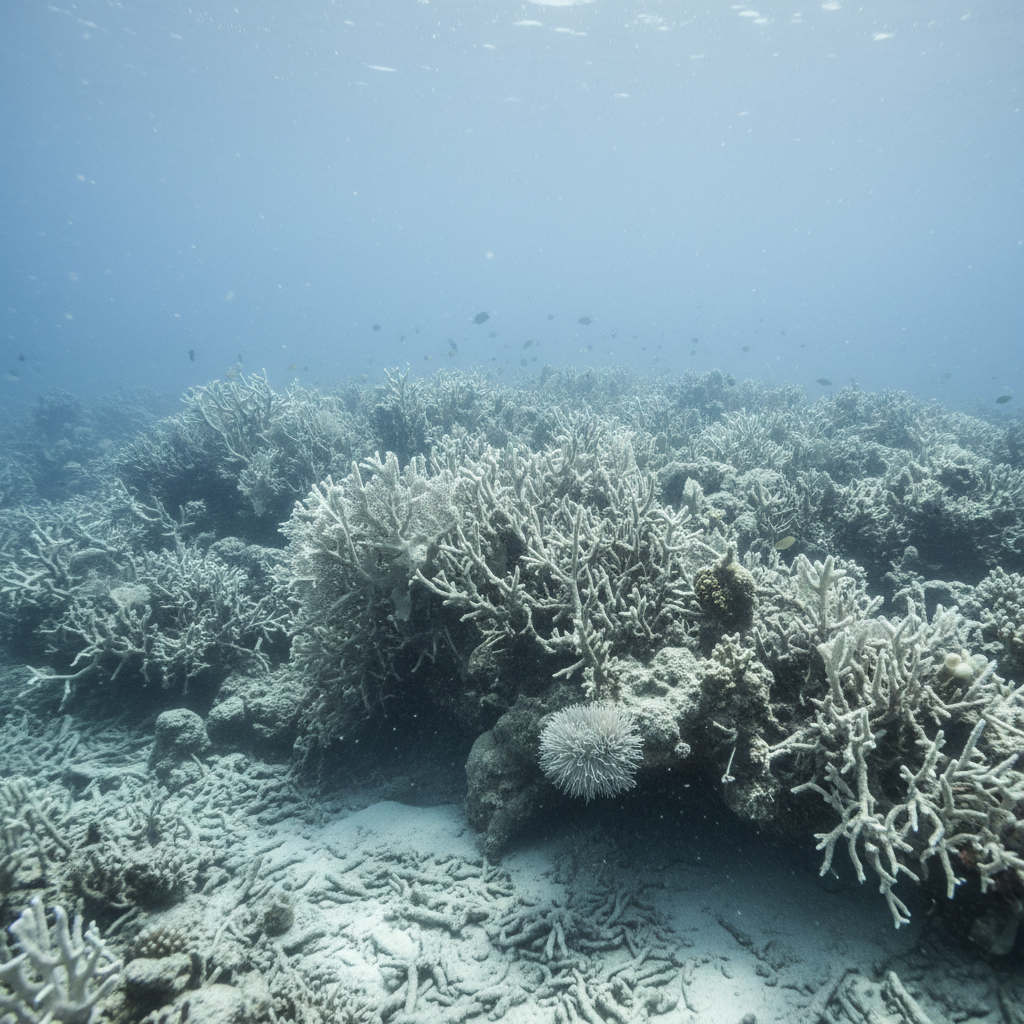
NOAA confirms the 4th global coral bleaching event on record. Rising ocean temperatures are triggering mass bleaching across the Atlantic, Pacific, and Indian Ocean basins.
Coral reefs cover less than 1% of the ocean floor yet support approximately 25% of all marine species. They are the rainforests of the sea — and they are dying at a rate that alarms scientists worldwide.
On April 15, 2024, NOAA officially confirmed the world's fourth global coral bleaching event — the second in the last ten years. According to NOAA Coral Reef Watch coordinator Derek Manzello, Ph.D., "From February 2023 to April 2024, significant coral bleaching has been documented in both the Northern and Southern Hemispheres of each major ocean basin."
Coral bleaching occurs when water temperatures rise just 1–2°C above the seasonal maximum for extended periods. Under thermal stress, corals expel the symbiotic algae (zooxanthellae) living in their tissues. These algae provide up to 90% of the coral's energy through photosynthesis. Without them, the coral turns ghostly white and begins to starve.
The scale of the 2023–2024 event is unprecedented. Mass bleaching was confirmed throughout the tropics, including Florida, the Caribbean, Brazil, the eastern Tropical Pacific, Australia's Great Barrier Reef, large areas of the South Pacific, the Red Sea, the Persian Gulf, and the Indian Ocean. NOAA's Atlantic Oceanographic & Meteorological Laboratory (AOML) documented complete bleaching at Cheeca Rocks in the Florida Keys on July 31–August 1, 2023. "I've never seen anything like it," said Ian Enochs, Ph.D., Research Ecologist and Lead of AOML's Coral Program. "The corals at our primary climate monitoring reef site, Cheeca Rocks, are completely bleached. No single coral is untouched. It's shocking."
In response to the unprecedented 2023 heat stress, NOAA's Coral Reef Watch updated its bleaching alert scale in December 2023, adding three new categories above the previous Level 2 maximum, up to a new Level 5 indicating "near complete mortality" risk (greater than 80% of corals at risk of dying).
Conservation efforts include coral gardening programs, where fragments of heat-resistant coral strains are grown in nurseries and transplanted onto degraded reefs. Through its Mission: Iconic Reefs program, NOAA made significant strides during the 2023 Florida bleaching event, including moving coral nurseries to deeper, cooler waters and deploying sunshades to protect corals. Scientists are clear: without dramatic reductions in greenhouse gas emissions, the world's coral reefs face functional extinction by 2050.
Sources & Attribution
This article is based on published research and official reports from credible marine science institutions. Full credit goes to the original authors and organizations listed below.
- 1NOAA — NOAA confirms 4th global coral bleaching event (April 15, 2024)
NOAA. (2024, April 15). NOAA confirms 4th global coral bleaching event. National Oceanic and Atmospheric Administration.
- 2NOAA AOML — Cheeca Rocks Reef Completely Bleached (August 2, 2023)
AOML Communications. (2023, August 2). NOAA Scientists Return to Cheeca Rocks, Find Reef Completely Bleached. NOAA Atlantic Oceanographic & Meteorological Laboratory.
- 3NOAA Climate.gov — Coral Reef Watch extends alert scale following extreme 2023 heat stress
NOAA Climate.gov. (2024). NOAA Coral Reef Watch extends alert scale following extreme coral heat stress in 2023.