A comprehensive species-level inventory of marine bioluminescence finds the phenomenon distributed across all major animal groups in the ocean — from bacteria to fish.
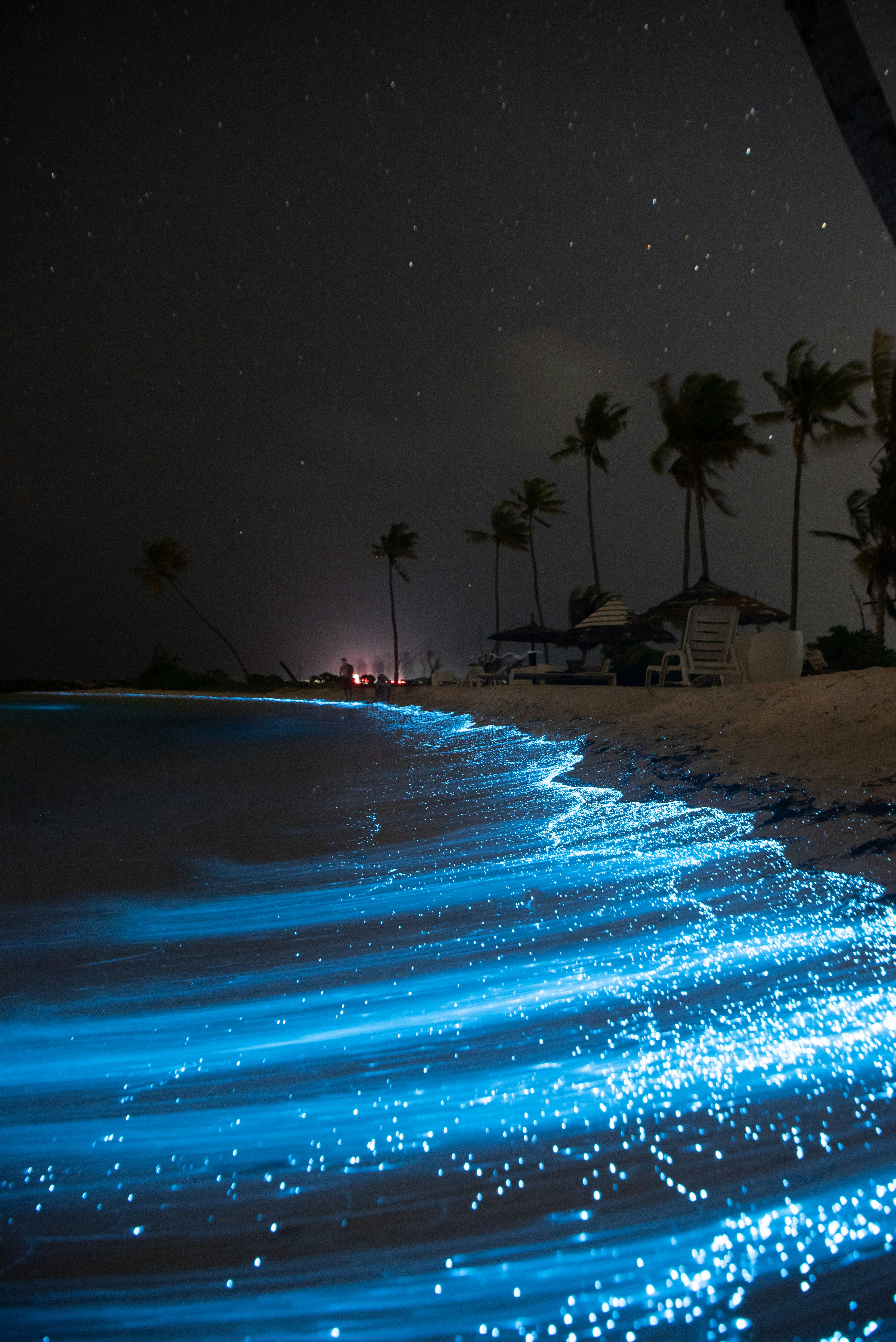
Walk along a beach on a dark night and you might witness one of nature's most spectacular phenomena: waves that glow electric blue with every crash. This is bioluminescence — the production and emission of light by living organisms — and the ocean is its greatest stage.
A comprehensive 2024 study published in the journal Life (Claes, Haddock, Coubris & Mallefet, 2024, DOI: 10.3390/life14040432) presents the first systematic, species-level inventory of bioluminescence across marine animals. The research, co-authored by MBARI senior scientist Steven Haddock — one of the world's foremost experts on deep-sea bioluminescence — documents the distribution of light production across all major marine animal groups.
The chemistry is elegant: a light-emitting molecule called luciferin reacts with oxygen in the presence of an enzyme called luciferase, releasing energy as photons rather than heat. This reaction has evolved independently dozens of times across the tree of life, making bioluminescence one of the most striking examples of convergent evolution in nature.
Different organisms use bioluminescence for different purposes. Dinoflagellates — single-celled plankton — flash when disturbed, creating the glowing waves seen from beaches. This "burglar alarm" response is thought to attract larger predators that eat whatever is disturbing the plankton. Anglerfish dangle bioluminescent lures to attract prey in the pitch-black deep sea. Firefly squid (Watasenia scintillans) use complex light patterns for communication and camouflage.
The deep ocean is where bioluminescence reaches its most elaborate expression. Below 200 meters, where sunlight cannot penetrate, the vast majority of organisms produce light. Many use bioluminescence for counter-illumination — producing light on their undersides to match the faint glow from above, making them invisible to predators looking up from below.
Scientists are harnessing bioluminescent proteins for medical research, using them as markers to track cancer cells, monitor gene expression, and image brain activity in real time. The ocean's living light is not just beautiful — it is illuminating the frontiers of biology.
Sources & Attribution
This article is based on published research and official reports from credible marine science institutions. Full credit goes to the original authors and organizations listed below.
- 1Claes, Haddock, Coubris & Mallefet (2024) — Systematic Distribution of Bioluminescence in Marine Animals: A Species-Level Inventory (Life)
Claes, J.M., Haddock, S.H.D., Coubris, C., & Mallefet, J. (2024). Systematic Distribution of Bioluminescence in Marine Animals: A Species-Level Inventory. Life, 14(4), 432. https://doi.org/10.3390/life14040432
- 2MBARI — Bioluminescence Research (Steven Haddock Lab)
Monterey Bay Aquarium Research Institute (MBARI). Bioluminescence research — Steven Haddock Lab.